
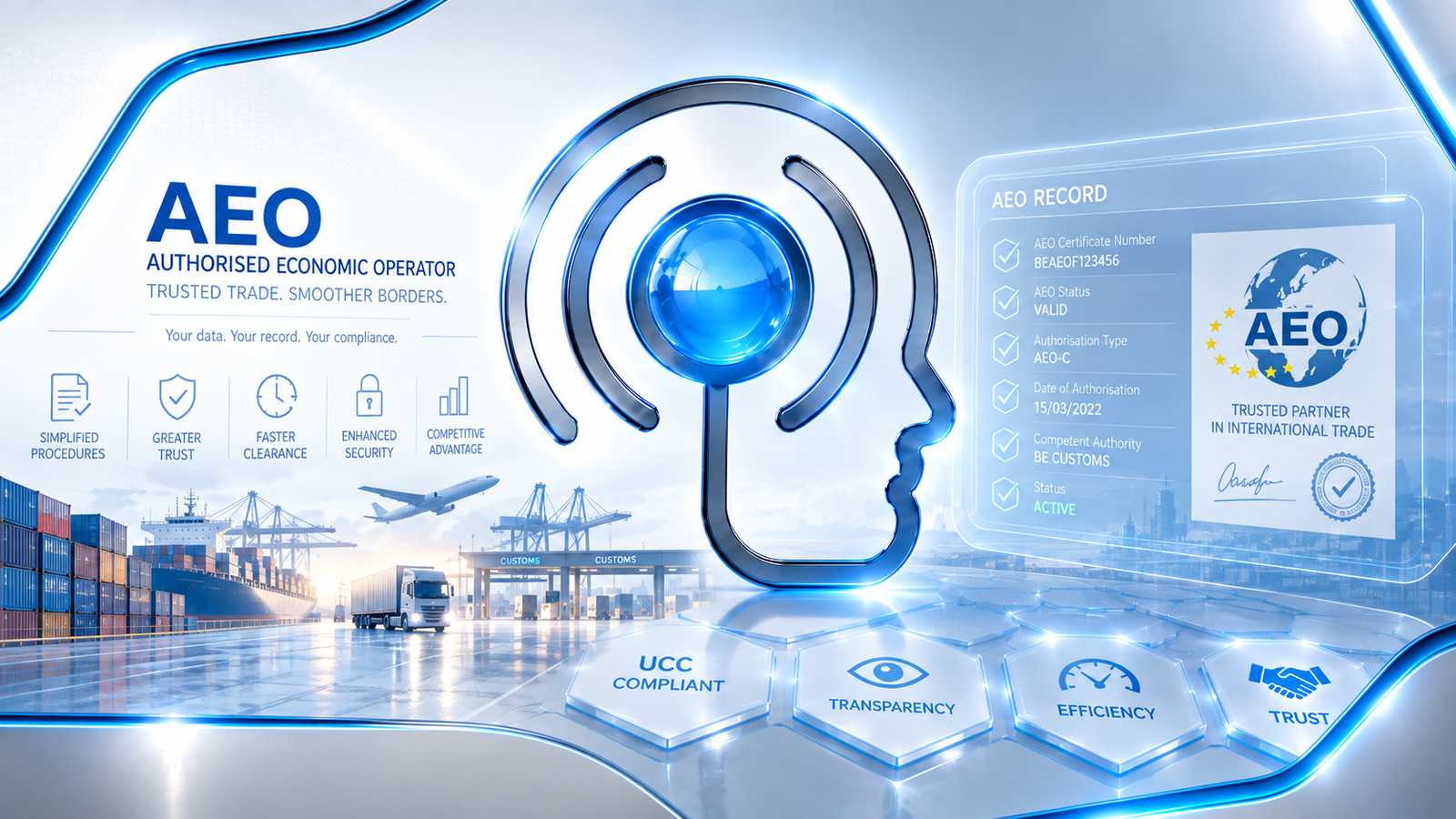
Continuous compliance automation has transformed the way ISO certificates are managed: connect your systems, collect the evidence, watch the dashboard stay green. It was only a matter of time before the same model was proposed for AEO. It is a tempting idea — and it works for exactly three of the five criteria. The two it cannot carry are the ones that decide whether you keep the status.
Why AEO suddenly matters more
Authorised Economic Operator status has always been valuable. In the current enforcement climate, it is becoming load-bearing. Customs administrations are publicly stepping up inspections; low-value regimes have been rewritten mid-year; product-compliance rules are now enforced at the moment of customs release. Companies respond by seeking the simplifications, guarantee waivers and lighter controls that AEO unlocks — and by building their logistics models on top of them. That is the point too easily missed: once your operating model assumes AEO, the status is no longer a badge on the website. It is infrastructure. Losing it is not a reputational event; it is a supply-chain event, with consequences that reach the loading dock the next morning.
Five criteria, two natures
The AEO criteria of Article 39 of the Union Customs Code look like a checklist: compliance record, satisfactory management of records, financial solvency, practical standards of competence, and — for the security variant — appropriate security standards. But the five are not of the same nature.
Solvency, competence and security are attestation matters. They are demonstrated with documents, filings, training records and site audits, and they change slowly. This layer automates well — the continuous-monitoring model that transformed ISO management applies to it almost unchanged, and there is real value in automating it.
The compliance record, and the substance behind records management, are different in kind. They are flow matters. Your compliance record is not a document in a drawer; it is the accumulated correctness of every declaration you file, measured against customs law as it stands at the moment of filing. You cannot attest it. You produce it, daily — or you don't.
Where the ISO analogy breaks
The analogy with ISO-style certification management fails on three hinges at once.
The referent. An ISO audit checks you against your own documented system: the standard asks whether you do what you wrote. AEO's decisive criterion checks you against external law, applied to every transaction. Nobody fails an ISO audit because a regulation changed; AEO holders can drift out of conformity without changing anything at all — the rulebook moved underneath them.
The cadence. An ISO standard holds still for years between revisions. The customs rulebook does not currently hold still for a quarter: the low-value import regime adopted this year carries a monthly review clock inside the act itself. A conformity model built for a stable referent meets a referent that moves.
The failure mode. An ISO non-conformity earns a finding and a correction window; business continues. A serious customs infringement earns suspension or revocation — and because AEO is load-bearing, the consequences are operational immediately. Put simply: if your compliance dashboard goes down, the company keeps running. If the customs function stops, the trucks stop.
What "maintaining AEO" therefore means
It follows that AEO cannot be maintained in isolation, the way an ISO certificate can. Three of its five criteria can — and should — be handled as attestation. But the status as a whole stands or falls with the criterion that is the operations themselves. Maintaining it means three things happening continuously: every transaction evaluated against the checkpoints that carry the AEO criteria; the underlying knowledge of customs law kept demonstrably current; and deviations caught and corrected before they accumulate into the "serious or repeated infringements" that end the conversation.
And one caution for the connected age: monitoring the flow is not judging the flow. Systems integration can surface every transaction as it happens — but visibility tells you only what was filed, never whether it was right; that judgment takes the current rulebook, and something in the loop that holds it.
The administration's own method confirms the standard: AEO holders carry a continuous obligation to notify anything affecting the criteria, and reassessments proceed by transactional audit. A green dashboard will one day meet an auditor who samples real declarations. That meeting goes well only if something in your loop has been looking at the same declarations, with the same law, all along.
AEO as a view, not a product
This is why Viictor was never built as an AEO-only tool — and why it handles AEO better for it. In Viictor, AEO is literally one compliance framework among others. You switch on the authorisations you are pursuing — AEO customs simplifications, security and safety, inward processing, customs warehousing, the authorised CBAM declarant status — and readiness is derived, continuously, from one underlying picture of your customs function, domain by domain. The declarative layer establishes the framework; configuration turns it into checkpoints and measures; operation keeps it true, transaction by transaction.
That derivation is not a feature one bolts onto a dashboard. It takes an engine that reasons over customs law the way an expert does and verifies the way an auditor does — a neuro-symbolic approach, pairing structured customs knowledge with modern AI, whose core mechanisms are the patent-pending outcomes of years of Research & Development. And the engine is the smaller half: the corpus it reasons over distils twenty-five years of customs practice. Anyone can render a readiness percentage. Rendering one that an auditor's sampling will later confirm is the hard part — and the hard part is the product.
The practical consequence is the difference between two roads into certification. A standalone certification tool must build the foundations of the customs function before its promise means anything. A governed function projects any certification as a view — assembled by configuration, sustained by operations. And the regulator keeps inventing new frameworks to project: what serves AEO today serves the next authorisation tomorrow, from the same substrate. Chase certificates one by one, and you buy a dashboard per certificate. Govern the function once, and every certificate becomes a view of it.
AEO is where that argument is most visible today. It will not be the last place.
Viictor's early-adoption phase is open. If AEO readiness — obtaining the status, or keeping it — is on your agenda, it is one of the concrete cases early adopters are exploring with us. Start at viictor.vivansa.com.